

THIS WEEK
Justin Drake Warns of AI Risk to Classical Cryptography
Department of War Announces Additional $350 Million in Quantum Computing Initiatives
Project Eleven Shares PQ Custody Infrastructure Product
LEAD
Justin Drake “Bunker Mode” Warning
10/7/2026 | Justin Drake tweet

| Vitalik response

| Head of Cryptography at Coinbase response


Justin Drake, Ethereum researcher, shared a tweet calling for the blockchain industry to set in motion a “controlled mass migration of assets to fresh addresses” under what he describes as “bunker mode.” Drake’s primary reasoning is his belief in the potential of AI to challenge the security of ECDSA prior to the existence of a quantum computer, with a “worst case in months, not years.”
Vitalik Buterin, Ethereum co-founder, replied, countering that he doesn’t recommend “anyone scramble to move their funds to new wallets today” but that “we should take risks to cryptography from AI-accelerated math seriously, and minimize our exposure to not just quantum-vulnerable cryptography, but also potentially AI-vulnerable cryptography.” Vitalik goes on to note that he views the AI risk as also present in PQ cryptography, including “ML-DSA / FHE / lattices,” with hash-based cryptography being preferred for Ethereum’s PQ roadmap.
Yehuda Lindell, Head of Cryptography at Coinbase, replied as well, stating that to his “understanding there is no evidence whatsoever pointing to a break of decades-old hardness assumptions like elliptic curve cryptography.”
NETWORK UPDATES
Stacks Shares Roadmap Touching on Plans for Post-Quantum Security
Stacks shared a roadmap outline naming post-quantum security as one of three priorities for Stacks by 2030, stating that Stacks will move to PQ cryptography and that Stacks can adopt PQ signature schemes independent of Bitcoin’s upgrade schedule.
StarkWare Discusses Starknet Becoming an Independent L1, Citing Quantum and AI Risk to Classical Cryptography
10/7/2026 |


|


|

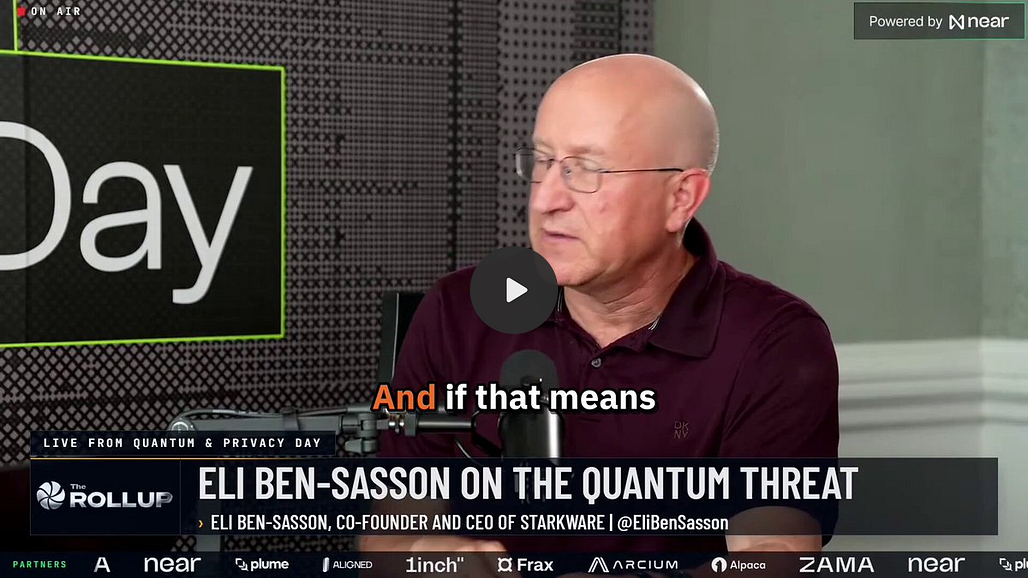
StarkWare CEO Eli Ben-Sasson opened a discussion on Twitter on the subject of Starknet transitioning from an Ethereum L2 to a standalone layer 1, citing that Starknet’s current dependencies on Ethereum may pose risk in the face of a cryptographically relevant quantum computer. The Starknet Twitter account further tweeted that “we are actively considering becoming an L1” to become a “fully quantum-resistant network.”
Ethereum Foundation Hosts 2nd Annual PQ Research Retreat
10/9/2026 |


The Ethereum Foundation hosted its second post-quantum research retreat in Cambridge, UK, running from Oct 9 to Oct 12.
Ethereum Researchers Outline Path for PQ Proofs on Ethereum
10/8/2026 | https://ethresear.ch/t/exposing-an-isa-for-post-quantum-proofs-on-ethereum/26136 |

Ethereum researchers have shared an Ethereum Research post outlining paths for supporting post-quantum proofs on Ethereum, contingent on EIP-8288, which would allow proofs to be verified outside the EVM. This requires a standardized Instruction Set Architecture (ISA), with the post outlining the options for the ISA as the EVM, RISC-V, or a specifically designed Ethereum ISA. The post does not make any specific recommendation on which option should be pursued.
Zakura Targets PQ Signature Opcodes in Zcash by Jan 2027
10/8/2026 | https://zakura.com/engineering/transparent-pir-rotating-addresses/
Zakura, a full node implementation for Zcash, shared that its team “plans for post-quantum signature opcodes to land in Zcash in January.”
INFRASTRUCTURE & VENDORS
Project Eleven Launches PQ Custody Infrastructure, Strongpoint, with Zcash Foundation as Initial Dev Partner, Plans with Quantus
10/7/2026 | https://www.prnewswire.com/news-releases/project-eleven-launches-strongpoint-for-post-quantum-custody-with-zcash-foundation-as-initial-development-partner-302900327.html | https://www.prnewswire.com/news-releases/project-eleven-and-quantus-plan-strongpoint-integration-with-quantus-joining-as-a-development-partner-302901664.html
Project Eleven introduced Strongpoint, a custody platform “built for navigating the transition to post-quantum cryptography.” The Zcash Foundation is noted as an initial development partner. Additionally, Project Eleven and Quantus announced plans to “integrate the Quantus Network with Strongpoint.”
BTQ Technologies Strategic Partnership with MoonPay Korea, Security Partnership with “Focus on Post-Quantum Cryptography”
BTQ Technologies Corp shared a press release stating it has been named security partner for MoonPay Korea’s stablecoin infrastructure, “with a focus on post-quantum cryptography.” The release notes both a quantum-transition roadmap and a proof of concept of BTQ’s Quantum Secure Stablecoin network with Korean banking institutions as two items in the partnership scope.
QUANTUM HARDWARE & ESTIMATES
IonQ Demonstrates Quantum Memory-Enhanced Interconnect for Distributed Quantum Applications
IonQ announced that the company had achieved entanglement rates “above 1,000 per second between a trapped ion qubit and a solid-state memory, through a photonic interconnect.” The announcement from IonQ states that the rates are “more than four times faster than the previous record for trapped ions.”
POLICY & REGULATION
Europol Releases Report on Quantum Risk to Cryptocurrency Wallets
Europol released a report by its European Cybercrime Centre evaluating the potential impacts of quantum computing on cryptocurrencies. The report states that it sees the primary risk as lying in the “vulnerability of cryptocurrency wallets” and advises proactive adaptation by blockchain projects.
Department of War Announces $350 Million in Quantum Computing Initiatives
10/8/2026 | https://www.war.gov/News/Releases/Release/Article/4622109/department-of-war-announces-350-million-in-quantum-computing-initiatives/ | https://www.war.gov/News/Releases/Release/Article/4622113/department-of-wars-office-of-strategic-capital-signs-150-million-conditional-lo/
The Office of the Under Secretary of War for Research and Engineering announced new “initiatives and programmatic updates totaling approximately $350 million to strengthen U.S. leadership in quantum computing capabilities that support national security.” The package includes approximately $200 million in new DARPA funding to advance four quantum computing providers to Stage C of its Quantum Benchmarking Initiative, and a $150 million conditional loan commitment from the Office of Strategic Capital to PsiQuantum.